or toy brands, retailers, importers, and private-label sellers, requesting an OEM quote for custom building blocks is an exciting step. But many buyers send vague inquiries like “Please quote a custom building block set” and receive equally vague answers—or no reply at all.
A clear, well-prepared inquiry helps a building block factory:
- Understand your product concept quickly
- Provide a realistic quotation range
- Suggest suitable molds, parts, and materials
- Identify potential issues early
- Respond faster with useful options
This guide explains what to prepare before asking a building block factory for an OEM quote, so you get accurate, actionable responses instead of generic price lists.
Why Preparation Matters
An OEM quote is not a standard price list. It depends on many variables:
- Product complexity and number of new parts
- Mold requirements and tooling investment
- Color customization and material needs
- Packaging format and printing complexity
- Order quantity and MOQ
- Testing and compliance requirements
- Target market and destination
The more complete your initial information, the more accurate and useful the factory’s response will be.
A well-prepared inquiry also signals that you are a serious buyer, which can lead to better communication, faster sampling, and stronger long-term support.
What to Send: A Complete OEM Inquiry Checklist
Below is a practical checklist of what to prepare before contacting a building block factory for an OEM quote.
1. Product Idea
Start with a clear description of your product concept.
Include:
- What is the product? (for example, “A STEM mechanics building set for ages 8+”)
- What is the theme or story? (for example, “City construction,” “Castle adventure,” “Space exploration”)
- What is the main play value? (building, learning, collecting, etc.)
- How does it fit into your existing product range?
Even a short paragraph helps the factory understand your vision.
Example:
“We want to develop a 300-piece castle building set for children aged 6–10. The set should include arches, slopes, windows, and decorative elements, with a focus on open-ended building and themed play.”
2. Reference Images
Reference images help the factory visualize your idea.
You can provide:
- Photos of similar products you like
- Sketches or hand-drawn concepts
- Screenshots from catalogs or websites
- Mood boards for colors, themes, or styles
Note: Reference images are for concept direction, not for copying protected designs or trademarks. Make it clear that you are using them for inspiration, not replication.
Example:
“Here are 3 reference images showing the style of castle sets we like. We want a similar size and complexity but with our own unique design and colors.”
3. 3D Files (If Available)
If you have 3D files (for example, STEP, STL, or CAD formats), share them with the factory.
3D files help the factory:
- Understand exact dimensions and geometry
- Assess mold feasibility and cost
- Identify which parts can use existing molds
- Provide more accurate quotations
If you do not have 3D files, that is okay. Many manufacturers offer design support as part of OEM services.
Example:
“We have 3D files for two custom brick shapes. Please review and advise on mold feasibility and cost.”
4. Target Size
Specify the approximate size of the product or set.
This may include:
- Overall dimensions of the built model (for example, 30 × 20 × 25 cm)
- Size of individual bricks or special parts
- Packaging size (if you have a target)
- Carton size or weight limits (if relevant)
Target size helps the factory estimate:
- Mold size and cost
- Material usage
- Packaging dimensions
- Shipping volume
Example:
“The built castle should be approximately 30 × 20 × 25 cm. We prefer a color box around 40 × 30 × 10 cm.”
5. Quantity
Provide your expected order quantity.
This helps the factory:
- Assess MOQ feasibility
- Calculate unit pricing at different volumes
- Determine mold amortization
- Plan production capacity
If you are not sure, provide a range (for example, 1,000–3,000 units) and ask for tiered pricing.
Example:
“We are considering an initial order of 2,000 sets, with potential for repeat orders of 5,000+ if sales are strong.”
6. Target Market
Specify the country or region where you plan to sell.
This helps the factory:
- Understand applicable safety and compliance requirements
- Suggest appropriate testing standards
- Advise on labeling and packaging language
- Consider market-specific preferences
Example:
“Our target market is the United States, so we need ASTM F963-related testing and appropriate labeling.”
7. Age Range
Define the target age group for your product.
This affects:
- Part size and complexity
- Small-parts considerations
- Safety testing requirements
- Packaging warnings and age grading
Example:
“The product is for children aged 6–10, so we need to ensure all parts meet safety requirements for this age group.”
8. Packaging Requirements
Describe your packaging preferences.
Include:
- Packaging type (color box, bag, tub, tray, etc.)
- Approximate size or dimensions
- Artwork or branding direction
- Language requirements
- Barcode, SKU, and importer information
- Any specific retailer or marketplace requirements (for example, Amazon FBA)
Example:
“We prefer a full-color box, approximately 40 × 30 × 10 cm, with our logo and product name on the front. We need a barcode and age warning label.”
9. Logo
If you have a logo, provide it in a usable format.
Include:
- High-resolution logo file (AI, EPS, PDF, or PNG)
- Brand colors or Pantone codes
- Logo placement preferences (front, back, sides of packaging)
- Any brand guidelines or style references
Example:
“Attached is our logo in AI format. Please place it on the front and back of the box, using our brand blue (Pantone 285 C) as the primary color.”
10. Color Requirements
Specify your color needs for bricks and packaging.
Include:
- Desired colors for bricks (standard or custom)
- Color ratios or mixes (if applicable)
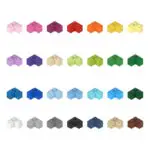
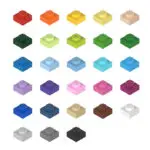
- Any special colors or effects (translucent, metallic, pastel, etc.)
- Color references (Pantone codes, swatches, sample products)
Example:
“We want a custom color mix with 40% blue, 30% grey, 20% white, and 10% yellow bricks. Please match our brand blue (Pantone 285 C) for the blue bricks.”
11. Testing Requirements
Clarify which safety and compliance tests you need.
Include:
- Target market standards (for example, ASTM F963, EN 71, etc.)
- Any specific tests required (mechanical, chemical, small parts, etc.)
- Whether you need test reports or certificates
- Who will arrange testing (factory, buyer, or third-party lab)
Example:
“We need ASTM F963 testing for the US market. Please advise on the testing scope, cost, and timeline.”
Optional but Helpful Information
In addition to the core checklist, the following details can help the factory provide a more accurate quote.
Budget Range
If you have a target unit cost or total budget, share it. This helps the factory propose realistic options.
Example:
“Our target landed cost is USD 8–10 per set for a 2,000-unit order.”
Timeline
If you have a specific launch date or deadline, mention it.
Example:
“We need samples by [date] and bulk production completed by [date] for a holiday launch.”
Existing Product or Sample
If you have a similar product or sample, send it or describe it in detail.
Example:
“We have a sample of a similar set from another supplier. We want to improve the clutch power and add our own colors and packaging.”
Special Requirements
Mention any unique needs, such as:
- Specific compatibility requirements
- Special packaging features (windows, handles, etc.)
- Sustainability or material preferences
- Intellectual property or exclusivity needs
Example:
“We need the bricks to be compatible with major brands. We also want the molds to be exclusive to us.”
How to Structure Your OEM Inquiry
A well-organized inquiry is easier for the factory to read and respond to. Use a clear structure such as:
Sample OEM Inquiry Template
Subject: OEM Quote Request – Custom Building Block Set
Product Idea:
[Describe your concept in 2–3 sentences.]
Reference Images:
[Attach or link to reference images.]
3D Files:
[Attach if available, or note that you do not have them.]
Target Size:
[Specify model and packaging dimensions.]
Quantity:
[Provide expected order quantity or range.]
Target Market:
[Specify country or region.]
Age Range:
[Define target age group.]
Packaging Requirements:
[Describe packaging type, size, artwork, and compliance needs.]
Logo:
[Attach logo file and placement preferences.]
Color Requirements:
[Specify brick colors, ratios, and any special colors.]
Testing Requirements:
[Specify target-market standards and testing needs.]
Additional Notes:
[Include budget, timeline, or any special requirements.]
Request:
“Please review and provide an OEM quotation, including mold costs, sample fees, unit pricing at our target quantity, and estimated lead time.”
What Happens After You Send the Inquiry
Once you send a complete OEM inquiry, the factory will typically:
- Review your information – assess feasibility, mold needs, and cost factors.
- Ask clarifying questions – if any details are unclear.
- Provide a quotation range or detailed quote – including mold costs, sample fees, unit pricing, and lead time.
- Suggest alternatives – if your original concept is not feasible or cost-effective.
- Propose next steps – such as 3D design, prototyping, or sample production.
A professional factory will respond with useful, specific information rather than a generic price list.
Common Mistakes to Avoid
When requesting an OEM quote, avoid these pitfalls.
Sending Vague Inquiries
“Please quote a custom building block set” is too vague. Provide as much detail as possible.
Forgetting Target Market and Age
Without this, the factory cannot advise on testing, labeling, or safety requirements.
Not Providing Quantity
MOQ and unit pricing depend heavily on order volume. Provide a range if you are unsure.
Ignoring Packaging Details
Packaging affects cost, shipping, and perceived value. Include your preferences early.
Assuming All Colors Are Possible
Some colors are difficult to achieve in ABS plastic. Ask the factory for realistic options.
Skipping Testing Requirements
Testing affects cost and timeline. Clarify your needs upfront.
Start Your OEM Building Blocks Project
Preparing a complete OEM inquiry helps you get accurate quotes, faster responses, and better support from building block factories.
At Lione Toys, we welcome detailed OEM inquiries and can support you with:
- Product concept review and feasibility assessment
- 3D design, part selection, and prototype development
- New mold development and existing-mold optimization
- Color matching and custom color systems
- Packaging design and private-label branding
- Testing coordination and compliance documentation
- Tiered pricing and MOQ guidance
- Export documentation and shipment coordination
Send us your design or product idea for an OEM/ODM quotation.
Visit www.lionetoys.com to start your OEM building blocks project with a China toy manufacturer.