

“Compatible with major brands” is one of the most common claims in the building blocks industry. But for toy wholesalers, importers, distributors, and private-label brands, the phrase is only useful if it is backed by real engineering, consistent production, and verifiable quality.
Compatibility is not a marketing slogan. It is the result of precise mold design, controlled material behavior, tight tolerances, and systematic testing.
This article explains what determines compatibility, why some “compatible” bricks feel different from others, and what buyers should ask when sourcing building blocks compatible with major brands.
What Determines Compatibility?
When buyers ask whether building blocks are compatible with major brands, they usually mean:
Can these bricks connect securely with the bricks my customers already own, without being too loose or too tight?
Achieving this requires control over several technical factors.
Stud Dimensions
The stud is the round protrusion on top of a brick. Its diameter, height, and position determine how well pieces connect.
Key considerations include:
- Stud diameter and roundness
- Stud height relative to brick height
- Spacing between studs (for example, 8 mm grid in many systems)
- Consistency across all bricks in a production batch
If studs are too small or positioned incorrectly, bricks will feel loose. If they are too large, bricks may be difficult to connect or may stress other pieces.
Brick Dimensions
Overall brick dimensions must match the reference system so that:
- Bricks align correctly on the standard grid
- Plates, tiles, and slopes fit together as expected
- Multi-layer builds remain stable
- Specialty parts (windows, doors, wheels) align with standard bricks
Even small deviations in length, width, or height can accumulate across a large model and cause visible gaps or instability.
Connection Geometry
Compatibility is not only about studs. It also involves the tube-and-stud connection system inside the brick.
Important elements include:
- Inner tube diameter and wall thickness
- Tube position relative to outer walls
- Interaction between tubes and studs of the brick below
- Geometry of plates, tiles, and specialty elements
The connection geometry directly affects clutch power—the force required to connect and separate bricks.
Clutch Power
Clutch power is the term used to describe how firmly bricks hold together while still being separable by children.
Ideal clutch power means:
- Bricks connect with a satisfying “click”
- Structures remain stable during normal play
- Children can separate bricks without excessive force or tools
- Bricks do not fall apart easily but are not frustratingly tight
Clutch power is influenced by:
- Stud and tube dimensions
- Plastic material and flexibility
- Mold precision and wear
- Production tolerances
- Environmental conditions (temperature, humidity)
Too little clutch power leads to collapsing models. Too much clutch power frustrates users and can damage bricks over time.
Tolerance
Tolerance refers to the allowable variation in dimensions between individual bricks and between production batches.
Tight tolerances are essential because:
- A 0.05 mm difference on one brick may seem small, but across 20 bricks it can become visible
- Inconsistent tolerances cause some bricks to feel tight and others loose
- Specialty parts (windows, doors, wheels) may not align if tolerances drift
A professional manufacturer controls tolerances through:
- Precision mold design and maintenance
- Regular dimensional checks during production
- Statistical process control on key dimensions
- Batch-to-batch comparison against reference standards
Material Shrinkage
Plastic shrinks as it cools in the mold. Material shrinkage must be predicted and compensated for in mold design.
Factors affecting shrinkage include:
- Type of plastic (for example, ABS grade)
- Color masterbatch and additives
- Mold temperature and cooling time
- Wall thickness of the part
- Part geometry and complexity
If shrinkage is not properly managed, bricks may be slightly undersized or oversized, affecting stud fit, clutch power, and overall compatibility.
Experienced manufacturers adjust mold dimensions and processing parameters to account for shrinkage so that final parts match the target specifications.
Mold Precision
Mold precision is fundamental to compatibility.
High-quality molds provide:
- Accurate stud and tube geometry
- Consistent wall thickness
- Smooth surfaces and edges
- Minimal flash or defects
- Long-term stability over many production cycles
Molds must be:
- Designed using precise CAD data
- Manufactured with high-precision machining
- Regularly maintained and inspected
- Replaced or repaired when wear affects dimensions
A supplier that invests in precision molds is more likely to produce consistently compatible bricks over time.
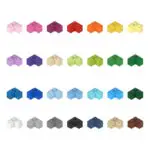
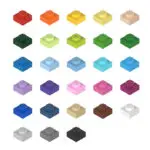
Color Consistency
While color does not directly affect mechanical compatibility, color consistency affects perceived quality and brand trust.
Customers expect:
- The same shade of red, blue, grey, etc., across batches
- No visible color variation within a set or bulk bag
- Stable color over time, without excessive fading
Color consistency is managed through:
- High-quality ABS and masterbatch
- Controlled mixing and dosing
- Regular color checks against approved standards
- Documentation of approved colors for repeat orders
Incompatible color shades do not stop bricks from connecting, but they can make a product feel “cheap” compared to major brands.
How Compatibility Is Tested in Production
Compatibility is not only designed. It must be verified through testing and quality control.
A responsible manufacturer should be able to describe how compatibility is checked, including:
Dimensional Inspection
- Measuring stud diameter, height, and position
- Checking overall brick length, width, and height
- Verifying tube dimensions and wall thickness
- Comparing results against target specifications and tolerance ranges
Clutch-Power Testing
- Using force gauges or test rigs to measure connection and separation force
- Testing multiple samples from the same batch
- Comparing results across different colors and part types
- Ensuring clutch power remains within an acceptable range
Interoperability Testing
- Connecting sample bricks with reference major-brand pieces
- Building test models (towers, walls, vehicles) to check stability
- Verifying that plates, tiles, slopes, and specialty parts align correctly
- Checking mixed builds that combine different part types
Batch Sampling
- Taking random samples from production runs
- Performing dimensional and clutch-power checks
- Comparing new batches to previous approved batches
- Investigating any drift in dimensions or connection feel
Visual and Functional Inspection
- Checking for flash, sink marks, scratches, or defects
- Inspecting surface quality and edge smoothness
- Testing moving parts, hinges, clips, and specialty elements
- Ensuring consistent appearance across colors
For toy products, safety testing is also important. Depending on the destination market, buyers may need to consider mechanical and physical testing, small-parts assessment, chemical testing, and age grading. In the United States, toys intended primarily for children aged 12 and under generally require third-party testing and certification. In the European Union, toys must meet applicable safety requirements before being placed on the market.developers.google+1
Why Some “Compatible” Bricks Feel Different
Not all compatible building blocks are equal. Buyers may notice differences such as:
- Bricks that feel looser or tighter than expected
- Sets where some pieces connect well and others do not
- Color variations between batches
- Specialty parts that do not align perfectly
- Bricks that become brittle or crack over time
These issues often stem from:
- Lower-precision molds or worn tooling
- Inconsistent material quality or excessive recycled content
- Poor control of shrinkage and processing parameters
- Weak quality-control systems
- Cost-driven compromises on dimensions and tolerances
A professional supplier will explain how they manage these risks rather than simply claiming “100% compatible.”
Questions Buyers Should Ask Suppliers
When sourcing building blocks compatible with major brands, go beyond the marketing claim. Ask technical and process questions.
About Molds and Tooling
- Are molds designed in-house or by specialized partners?
- What level of precision is used for mold manufacturing?
- How is mold wear monitored and managed?
- How often are molds inspected or maintained?
About Materials
- What plastic material is used (for example, ABS grade)?
- How is color masterbatch controlled?
- Is recycled material used, and if so, how is quality ensured?
- How is material shrinkage accounted for in mold design?
About Tolerances and Testing
- What tolerances are targeted for key dimensions?
- How are stud and tube dimensions checked during production?
- Is clutch power measured systematically?
- How are new batches compared to previous approved batches?
About Compatibility Verification
- Are bricks tested against reference major-brand pieces?
- Are test builds performed regularly?
- How are specialty parts (windows, doors, wheels) checked for alignment?
- Can the supplier provide sample bricks for your own compatibility testing?
About Quality Control
- What inspection steps are in place during production?
- How are defective parts identified and removed?
- Is there a system for tracking batch quality over time?
- How are customer complaints or returns investigated?
The answers to these questions will tell you whether a supplier truly understands compatibility or is just repeating a common marketing phrase.
Compatibility as a Long-Term Commitment
Compatibility is not a one-time achievement. It is a long-term commitment to:
- Maintaining mold precision over thousands of production cycles
- Keeping material specifications consistent
- Monitoring tolerances and clutch power batch after batch
- Updating processes when new part types are introduced
- Supporting customers with replacement parts that match earlier production
For toy businesses, this matters because:
- Customers expect new bricks to work with old ones
- Schools and programs rely on consistent parts over years
- Replacement-part programs require stable dimensions and colors
- Private-label brands need reliable quality to protect their reputation
A supplier that treats compatibility as an ongoing engineering discipline is a better long-term partner than one that treats it as a sales claim.
How Lione Toys Approaches Compatibility
At Lione Toys, we approach building blocks compatible with major brands from an engineering and quality-control perspective.
Our focus includes:
- Precision mold design to achieve accurate stud, tube, and brick dimensions
- Controlled ABS material selection to manage shrinkage and ensure consistent clutch power
- Systematic dimensional checks on key features during production
- Clutch-power testing to keep connection force within a comfortable range
- Interoperability testing with reference pieces to verify real-world compatibility
- Batch-to-batch comparison to maintain consistency over time
- Color control using high-quality masterbatch and approved color standards
- Support for safety testing and documentation for target markets
We understand that “compatible” is only meaningful if it is consistent, reliable, and verifiable across large volumes and multiple production runs.
Request Compatible Building Blocks Catalog
If you are a toy wholesaler, importer, distributor, retailer, or private-label brand, building blocks compatible with major brands can be a strong part of your product range.
At Lione Toys, we support buyers with:
- Bulk compatible building blocks by weight or piece count
- Loose bricks, plates, slopes, tiles, wheels, windows, doors, and specialty parts
- Technic-style components for advanced builders
- Custom color mixes and themed assortments
- Replacement-part programs
- Complete building block sets
Request our compatible building blocks catalog to discuss your target product, quantity, packaging, and destination market.
Visit www.lionetoys.com to start your compatible building blocks project.